Showing posts with label Emerging Market. Show all posts

Wednesday, April 27, 2011

Business: Alison Mary Ching Yeung on China Homegrown Luxury Brands


Founded by designer Alison Mary Ching Yeung in 2006, Mary Ching is one of the first high-end footwear and accessories brands to emerge from mainland China. Driven by Alison’s own eclectic aesthetic, Mary Ching seamlessly fuses Asian elements with vintage fashion without ever succumbing to “East Meets West” conventions. A regular sight at her flagship boutique on Ferguson Lane, which opened in 2009, Alison will appear next in London at theWalpole British Luxury Summit on May 17, where she will 
speak about the luxury market in the Greater China region.


Mary Ching creative director, Alison Mary Ching Yeung
Mary Ching creative director
Alison Mary Ching Yeung
Monday, April 25th, 2011 In Arts , via JingDaily


Recently, Jing Daily spoke to Alison about Mary Ching and her thoughts on the potential for homegrown Chinese luxury brands.
Jing Daily (JD): Tell us a little about Mary Ching.

Alison Mary Ching Yeung: If “Alice In Wonderland” had a sexy boudoir, it would be the Mary Ching boutique in Shanghai. Mary Ching gave her virginity to the city as China’s first luxury shoe and accessories brand in 2008. The products include vertiginous platform stilettos, saucy d’orsay pumps, and elegant flats in tantalizing textures and shades.
The flagship boutique…on Ferguson Lane showcases a delightful treasure box. In May 2010, ELLE France described Mary Ching as “La Louboutin Shanghaienne.”  Mary Ching has also joined the mile high club on Cathay Pacific and Dragon Air, where we sell leather and cashmere slippers, and is included in the permanent collection of the Victoria & Albert Museum to represent contemporary Chinese design. Mary Ching was shortlisted as a finalist for the “Creativity Award” sponsored by BP for the British Business Awards.
As the founder, I was always accused of having a shoe sickness by my father. So what better way to transform a sickness to a viral disease!
JD: Where and who are your target customers? Who have been your best customers to date? Where are they located? How do most of your customers find you?
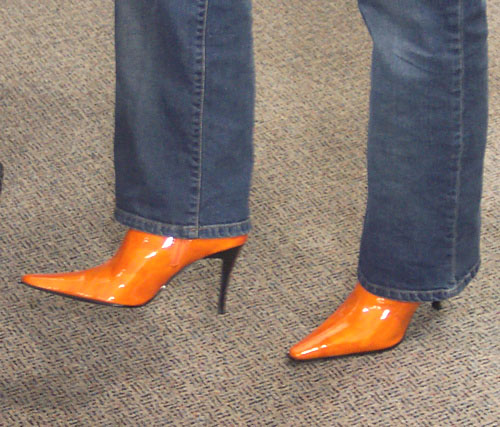
Mary Ching, the Jennifer shoe £259 (€299, $399, ¥2,600)
Alison: With the luxury market so large, fast-growing and young, there is a growing number of sophisticated and self-confident consumers willing to move beyond established big label brands and to try new, young and cutting edge designs to express their individuality. This trend can also be partly seen in the “discovery” of local brands by increasingly patriotic Chinese consumers.
The Mary Ching collector is a cosmopolitan, independent and young professional women aged between 25 to 40 years old. She is determined to make her own (fashion) statement and to be a fashionista trendsetter. It is a phenomenal market like no other where in second-tier cities, young professional women are willing to spend two or three months salary on purchasing luxury items.
Core customers are primarily in Asia but also are found in all corners of the world.
Clients and customers find us through fashion magazines exposure, online social networking and fundamentally through word-of-mouth. I am proud to say, ” We are the best-kept secret in the world.”

JD: Do you feel that China is ready for a domestic luxury brand like your own? What does it need to be ready?
Alison: While this trend is just at the initial phase, I like to refer to it as “the early stages of dating”: our brands are succeeding in seducing the consumer, and we are now close to the first kiss.
With the world’s attention on the booming mega-cities of China, Chinese fashion brands are quickly stepping into the spotlight. As the economy grows rapidly, so have the taste, habits and purchasing power of the Chinese people. As a consequence, local Chinese brands are moving to fulfill demand both at home and abroad. While in par, these up and coming Chinese brands are quick to learn successful retail strategies, marketing campaigns and powerful advertising from foreign brands entering China.
As the founder of Mary Ching, my vision is to create the first iconic Chinese luxury footwear and accessories brand. Vogue Editor Angelica Cheung once told me, “Keep doing what you do, as you are the only one doing it.” Her statement reflects how big the opportunity still is today in China.
I started Mary Ching believing that luxury homegrown luxury brands would be the future. As a “Eurasian” — as my father is Chinese and my mother British — I think there is a space for designers with Chinese heritage like myself to be educated abroad and then return to their roots.
JD: You’re very plugged into the luxury or fashion landscape in Shanghai. Could you describe your impressions of it? What events or strategies have you seen as successes?
Alison: China is currently the fastest-growing and second-largest luxury goods market in the world, second only to Japan. It is expected to reach the number one spot by as early as 2015. In 2009 Chinese consumers purchased 27.5 percent of the world’s luxury goods at a total of US$9.4 billion, in comparison to 2004 when their total was only $2 billion. In addition, the majority of China’s wealthy are young, with 80 percent below 45 years of age, compared to 30 percent in the United States and 19 percent in Japan.

There is no more exciting place to be than in Asia today. Chinese designers like me are in an advantageous position, as the Chinese media and press welcome us with open arms. Furthermore, there is increased government support to nurture Chinese luxury brands. I feel the brand is a success because Mary Ching has combined two different spirits to make a irresistible cocktail craved by all fashion addicts.
There are more and more young designers rising to international attention. A trend of locally born fashion brands, which is now in its infancy, will reach maturity in due course. Watch this space.
Mary Ching has seen success through a combination of marketing events (such as high-end fashion shows in Hangzhou, Shanghai and Beijing), exposure through Shanghai fashion week, and endorsements via Chinese celebrities and socialites. In par with these brand-building events, the strategy has been to focus on China and, most importantly, to keep a level of sophistication and high standards in creating a luxury brand.

To use an old Chinese proverb that best represents my philosophy, “When you hear something, you will forget it. When you see something, you will remember it. But not until you do something, will you understand it.”

Special thanks to Alison Mary Ching Yeung. Be sure to check out Mary Ching products on the Mary Ching website, or at its Shanghai boutique (376 WuKang Road, boutique 106). Mary Ching is also available at stores such as Brand New China (Beijing), Younik at Bund 18 (Shanghai), and Forest Bird(Hong Kong), as well as hotels like the Shangri-La (Beijing, Shanghai and Hong Kong), Peninsula (Shanghai) and Mandarin Oriental (Hong Kong). Full stocklist here.

Thursday, April 21, 2011

Today's Blog Readings and My Related Rant


There is a whole lot of bellyaching going on about the blue color and white color opportunities that are being 'stolen' by Chinese companies, and I fear it will only grow as we approach the 2012 Election Season. The complaints are coming from the left, right, center, and everyone in between. It isn't a partisan issue, this is an employment and economic issue.
Recently US companies have been in the news; see 'Obama Appoints GE's job killing former CEO to Council on Jobs and Competitiveness. Mr. Nuts on China now Heading US Job Effort.I would assert that who better than to consult on the 'competitive advantages' or lack thereof of US companies and workers as judged in comparison to the global marketplace? Should we have CEOs' who have no exposure or understanding of the issue? Wouldn't the proverbial "devils advocate' be the best person to poke holes in and improve a future US Policy? But I digress....
Source: Asia Matters
There is no doubt, there is and has been (for the last 20 years) a surge of manufacturing outsourcing to "emerging markets", not just China, but all over Southeast Asia, South America, and even former Eastern European countries. And, anyone who has called a customer service number knows that technical support and customer service call centers have been outsourced to India, Cebu, Panama, and even South Africa. Yes, we need to address why these countries have better bids on service and manufacturing jobs. We also need to accept that in most cases, the quality being delivered is equal if not superior to what their US competitors can offer in the same price point. 

....all of the above can be filed under the 'W' Weakness and 'T' for Threat in a standard SWOT analysis
But What about the other components in a SWOT? What are the Strengths the US service and manufacturing sectors can offer? And what Opportunities are available to these sectors because of the current global economy. And, why are some companies and States better at spotting the opportunities and seize on an action plan.


Source: Asia Matters for America

So ....here is an Opportunity...seize it! 
China's Massive construction booms in the Emerging Markets, including China create massive opportunities for designers, suppliers, and contractors. Blue collar,white collar, and green collar! The secret is listening for the opportunities, learning how to participate, and delivering a great product in order to grow business.
The original Article 
"Lighting Empire" , from Lighting April 8, 2011
With almost a quarter of the world’s population and the second largest economy after the US, China has immense potential for lighting designers and manufacturers. Andy Pearson investigates the opportunities. ..." Continue Reading >>
"....China is one of the world’s largest producers and consumers of lighting products. In 2008 it produced more than 15.4 billion lamps and that figure is increasing every year..... " Continue Reading >>
Be Local, Act Local, Win Local Business
Shanghai Abacus Lighting
"....Another prerequisite for selling into the Chinese domestic market is an ability to converse with customers. “I would recommend that the person running the operation is fluent in Mandarin,” says Morris-Richardson. Luise Schafer, vicechair of Abacus’ Shanghai arm, is fluent in Mandarin and it was her presence in China that gave Abacus the confidence to go it alone.....  Continue Reading >>
"....Caton’s advice for designers who want to enter the Chinese market is: “Develop contacts in China that know the market and culture because it will help you avoid pitfalls along the way”. He says PJC Lighting Design has no plans to open an office in China. “We manage very well handling schemes from London - we do have contacts in Hong Kong that  we use if necessary, but we do not have a formal relationship with them....” Continue Reading >>
"....Other lighting designers have not been so successful in China. Kevan Shaw, design director at Kevan Shaw Lighting Design says: “China is a very different place to do business, you have to be aware of the culture and you have to be able to stand up to pressure - to do more than you have agreed to do....” Continue Reading >>
Infrastructure Development Opportunities
"...Other lighting manufacturers are well established in China. Philips is one of the biggest, with 12 factories and a workforce of more than 10,000 employees. GE is another manufacturer with a major presence in China. Like Abacus, it is focused on the infrastructure business, which has developed as a result of the migration of the population into towns..." Continue Reading >>
"....The expansion of the market in China has also helped Hayakawa, a manufacturer and supplier of wire harnesses and cables, which has opened two factories in the country...." Continue Reading >>
International and Domestic Clients Need Expertise in China
"....Currently PJC Lighting Design is working on retail projects in Beijing, Shanghai and Hong Kong. Two of the projects are for local clients, the other is for an international client. Caton says the mix of projects is usually about 50:50 between international and domestic clients. “We usually get work through recommendation from an architect or interior designer who is more often than not based in London,” he explains..."  Continue Reading >>

Additional related reading:

Friday, April 15, 2011

Business: Luxury Spreading Far and Wide


China's maturing luxury goods market article, more demand for more kinds of luxury goods, Marketing
April 6, 2011 from China Bystander
Chinese already spend one of every eight dollars spent on luxury goods worldwide–as the proliferation of international luxury brand retailers from Armani to Louis Vuitton operating in the country and their growing dependence on its business already bear tony testimony. By 2015, Chinese consumers will be spending at least one dollar in every five, according to newly published researchby McKinsey (see original research article below), the international management consultancy. That adds up to sales of luxury watches, jewelry, handbags, shoes, and clothing of the order of 180 billion yuan ($27.5 billion), up from 80 billion last year.
Good news for the international luxury brands that Chinese consumers prefer? Up to a point. This broadening of their customers will move them out of their traditional niche of selling to the very rich. Mckinsey reckons that there are 13 million Chinese households with incomes of 100,000-200,000 yuan ($15,000-30,000)–upper middle class in China and on the first rung of the ladder of luxury consumption–and that this number will increase nearly sixfold to 76 million by 2015. Their share of the Chinese luxury goods market is forecast to grow from 12% last year to 22% by 2015, making it the fast growing sector of the market.
Addressing their needs requires a different marketing approach to the high-touch, for which read expensive, way luxury-goods makers are used to dealing with their best-heeled customers. That implies better in-store services and digital experiences for their customers, and the development of products and services designed for the local market (as Hermes is doing with its Shang Xia brand), three factors that have not always been the strong suit of luxury companies, especially their online strategies; the broad spread of social media is a particular challenge to the exclusiveness of a luxury brand. The luxury companies’ market will also spread from the the first tier cities to the second and third, compounding the reach and brand dilution issues, though it will also remain concentrated in the main cities.
Luxury-goods manufactures will also find that growing familiarity with luxury goods will make Chinese consumers more value conscious. Brand retailers won’t be able to get away so easily with just slapping a high price on their goods. Luxury goods prices in China are about 20% higher than even in Hong Kong. On the flip side, the research shows that as consumers get more brand conscious, they value craftsmanship and quality more, and are becoming more aware, and rejecting of, counterfeits.
McKinsey also predicts that spending on luxury services, such as spas and other wellness activities, will grow faster than that on luxury goods, another shifting sand for luxury retailers. The elephant in the room, though, is whether China will generate its own luxury brands as the once similarly foreign-brand besotted Japan has done. Original Article 


Tapping China’s luxury-goods market

By 2015, Chinese consumers will account for more than 20 percent of the global luxury market. How is their behavior evolving?

Related Posts Plugin for WordPress, Blogger...