Showing posts with label retail. Show all posts

Friday, April 6, 2012

J.C.Penny's in the Biz News Again

A few weeks ago I wrote a post about J.C. Penny's and the albatross around it's neck that is the old guard.


Looks like aside from lowering overhead costs they are also possibly addressing that issue.


Today's J.C. Penny's Headlines:


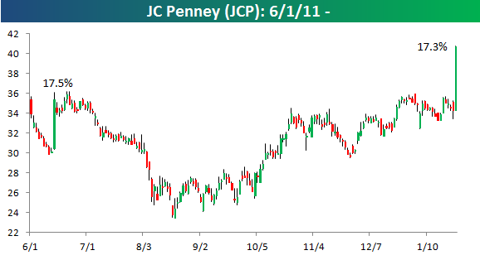
YTD J.C.Penny's stock climed in January but has fallen back to pre-January levels 
Since a stock price spike (here, here) in January JCP's stock price has declined since the over hyped pricing plan. While the newly introduced strategy may have been inspired by a 'stick to your knitting' historical business model it has resulted in an expected lack luster consumer acceptance.

The problem is, that at that time JCP was one of a small handful of retailers offering mail order service to rural areas. And that, along with the big city New York fashions are what made JCP a retail lynchpin. Today there are dozens of retailers that have adopted the fast fashion, low price, multi-channel business model. Therefore competing against established brands with not so new retail strategy is inane. While JCP does seem to be building a store within store model using strong-ish brands. Perhaps based upon their successful pre-Ron Johnson Sepora and Mango collaborations may prove to be value adders, however based on the already announced licensees I am doubtful. 


New York JCP Headquarters 
Another hunch I have about J.C. Penny's future is that they might take advantage sometime in the near future of the fact that the Plano Texas office headquarters was designed to work as a shopping mall as a back up plan in case their 1987 move from New York City was unsuccessful. JCP has a history of relocating its headquarters since it's inception in 1907 when James Cash Penny moved the retailer's headquarters to Salt Lake City in order to be closer to banks and railroads. In 1914 JPC's headquarters was moved again, this time to New York City to simplify the buying, financing, and transportation of goods. 


In January rumors were circling that JCP would move back to NYC but those were quickly quashed.  Although they do have plans to open a recruiting office in NYC which will double as a design office. This is an apparel industry norm for retailers to position their fashion staff in the hub of fresh fashion design. It is also a throwback to the original JCP model of delivering NYC fashion to all of America. In addition, NYC is where the best talent pool lives. At the same time JCP announced that they would open a San Francisco recruiting office. Purely conjecture on my part, but like the NYC apparel design move, San Francisco would be an ideal location for a home goods and accessory headquarter. Like NYC, the talent pool is deep in San Fran because William Sonoma has an established and well trained workforce ripe for the taking. In addition, like William Sonoma, it would make sense for JCP to locate it's technology headquarters in the Bay Area to capitalize on the local talent pool. 


Mass employee pilfering from Target also contributed to the rumors that a move from its valuable Plano Texas headquarters. Because key members of the merchandising team and  executive team will need to relocate from Minnesota anyway, a move to the left or right coast could be in the works. Although doing business in NYC and the Bay Area would be much more expensive. But, we must remember that Ron Johnson was located in Silicon Valley for quite a while and may have a penchant for the region and its progressive culture.


JCPenny's is listed on the New York Stock exchange as JCP (NYSE: JCP) $JCP


Saturday, March 17, 2012

Sell Your Employees in Order to Sell Your Customers

Refresh, Reboot, Reinvent


There is a great article/column in Forbes this week "JCPenny's New Stragegy A Tough Sell on the Sales Floor". It is a first person account of a family's quest in search of the perfect and perfectly priced sofa. The experiences the author describes ring true, especially for the home furnishings industry because we are very entrenched in discount pricing models and almost used car salesman techniques with artificial mark ups, crazy sales discounts, and spiffs.


However, beyond the initial shopping trip for a sofa is a much bigger lesson that applies to all industries and businesses. When making a strategic change to the business model it is imperative to remember that your team, whether they are in direct consumer sales, b to b service, or just in house administrative--they are your most important customer. If you do not take the time to win over your employees about the strategic shift of the company, then the shift will falter.


When Howard Schultz returned to Starbucks as CEO in 2007 he recognized that first and foremost he needed to focus on the core brand, its values, and its ethos. In order to do that he needed to retrain, reinvigorate, and refresh the workforce. He took the unprecedented move of closing down all the stores, flying managers into a central location and focusing on the details that, when combined are the Starbuck's brand. 
Onward: How Starbucks Fought for Its Life without Losing Its Soul
Link to Book


"On February 23, 2008, “I closed every store to retrain 115,000 people – I said we were going back to the roots of the company.” Of course, the media frenzy that ensued from this decision brought many to believe that the end of Starbucks was near – that they were no longer relevant. Schultz admits it was a bold decision to retrain every single employee. His explanation? “It was honest, it was authentic, and it was necessary.” The company lost $6 million that day. And as he said, Starbucks still had a long, long way to go in solving their mounting problems – but this was a start.
Starting over, he said, involved metaphorically asking the question of employees,What does it mean not to be a bystander? “From this point, we had to create, attract and create new customers.” Gone, he says, was the time that Starbucks could do no wrong — that the company was on a “magic carpet ride” – and that profitability and like-ability would happen automatically with every move the company made. Gone was the time that Starbucks was leading the conversation — now, they had to find a way to take part in the larger conversations that were happening." (source)


In the case of JCPenny's where they are trying to basically start an entirely new brand but based on a foundation of an old brand, retail stores, and employees, it is not enough to roll out a new ad campaign, pricing structure, and updated merchandise. 


If the railroad cars are not connected to the engine, the engine will still arrive at its destination, but with what to show for it?
JCP needs to take the time to establish and secure the connections between each boxcar before the engine leaves the station. Its too late now of course, but they still have time to catch up. As Schultz proved, an existing brand can be put back together if you take the time to stop the engine. Regroup, reconnect, and redefine together the action plan and shared goals. Hopefully JCP does this. 


For all those with businesses that need a refresh, remember that (1) it's not too late and (2) take the time in the beginning and continue to maintain the brand because that is always easier than a mid-journey stop and restart.

Wednesday, March 14, 2012

I'm a huge fan of the publications and research done by Interbrand. You can find their "knowledge" center is filled with wonderful insight into global retail, branding, marketing, product development, and much more and most are free to read and download. 


And, I've just listened to this podcast here. It's a fascinating discussion on the topic of Retail Innovation and the revolution/renaissance after the GFC.
Podcast Topics:
  • Brand
  • Design
  • Packaging
  • Promotions
  • Sensory perception
  • How People Shop
  • How to get your product on the shelf
  • How to get your product to sell off the shelf.

Tuesday, January 31, 2012

Amazon Stock Haters are Missing the Point

Why all the negativity? 


When JCPenny's, (NYSE: JCP) Sears , Service Merchandise, and all of the other big mail order companies of the day spent hundreds of millions on 600 page color catalogs they sent to customers, they lost money on those. 


When Pottery Barn (William Sonoma, Inc)(NYSE:WSM) sends out catalogs, they are investing in marketing. The margin on the actual printed catalogs is all negative. 


When Victoria's Secret (NYSE: LTD) answers the dreams of all men by sending out millions of catalogs annually, they are investing in marketing. They are losing money on those catalogs with the goal of attracting sales of their core products, undies!


Amazon's Kindle Fire is basically an electronic catalog that does not have to be reprinted and re-mailed every month. The fact that Amazon is selling their catalog, for any margin is great. That puts the ROI hurdle much lower than traditional multi-channel merchants, like those mentioned above. 


Once in a user's hand, I predict that Amazon will see 3 times retail sales increase by Holiday 2012.  


Amazon's future is in content delivery - media, products, digital, everything.
Additionally, the Prime Model is facilitating conversion of customers to the Amazon streaming and on demand media business. As they grow in importance they will be able to leverage better contracts with content providers. They are also becoming content creators. I predict that Amazon will be a big competitor to Netflix (NYSE: NFLX) in the next couple years. Just like Target, which used to have it's eCommerce hosted on Amazon, Netflix is hosted on the Amazon Cloud. At some point, that relationship will split, as Amazon takes over market share.


The one-click model, the KISS model will prove itself. And once again Jeff Bezos will be thinking "I tried to tell them, but they didn't believe we could do it."


Target Price: I see Amazon (NYSE: AMZN) ending out 2012 at $248 (it is now at $176.67 in after hour trading).


this is not a trade recommendation. i am not licensed or otherwise authorized to give financial planning advice. this is just my O-pin-ion.

Thursday, June 23, 2011

Innovative Products + Customer Experience Focus Boost Profits for Mid-High Price Point Home Furnishings Companies

Following is an excerpt from today's impressive annual and quarterly earnings release from Herman Miller. 


My Take-Away
  • In general the trend seems to be that mid to high price point products and retailers in the home furnishings and commercial furnishings (reference Bed Bath and Beyond (NYSE: BBBY) release yesterday) industry are fairing better than the lower or lower perceive price point and brand companies (reference La-z-Boy NYSE: LZB release yesterday).
  • Creating a pleasing customer experience in a broad channel of connection points including interactive and in person sales and service opportunities. 
  • Improved operating leverage including lower defect rates resulting in lower logistics costs Better inventory analysis and forecasting resulting in faster turns and lower inventory carry levels and fewer markdowns.  
  • Adjusted product assortment with larger offering of lower margin, higher volume products.
  • Fresh product introductions focusing on "innovation"
  • Expanding customer retention through initiatives including the Bed, Bath, Beyond and BuyBuy Baby wedding and baby registry synergies.
  • Taking advantage of down economy by improving market share through new customer aquisition; BBBY adding retail stores at lower leasing costs. MLHR increasing 


Web-Casts of Conference Calls

I am a big fan of listening to the quarterly conference calls. For some companies, including William Sonoma (Pottery Barn) I like to print out the transcript so I can highlight key points as I listen (they do great calls) (see my previous posts regarding William Sonoma here, here, here, here .) I glean all sorts of interesting information that is disclosed in the calls and through the Q&A following that isn't covered in the financials and listening I hear nuances that also speak volumes. 

You can listen to the Herman Miller MLRH webcast here . And the Bed, Bath, & Beyond web-cast here (the BBBY one is not so great because it wasn't very detailed and they took investor questions offline.)


Herman Miller, Inc. (NASDAQ: MLHR), today announced results for its fourth quarter ended May 28, 2011. The company reported net sales in the quarter of $441.5 million; an increase of 37.3% from the same quarter last fiscal year. Orders in the period of $448.5 million were 23.0% above the prior year level. Diluted earnings per share in the fourth quarter of fiscal 2011 were $0.30 compared to $0.00 in the prior year period.

For the full fiscal year, net sales were $1,649.2 million, reflecting a year-over-year increase of 25.1%. Adjusted diluted earnings per share, which excludes the impact of restructuring expenses, were $1.09 and $0.66, in 2011 and 2010, respectively. Diluted earnings per share in fiscal 2011 and 2010 were $1.06 and $0.43, respectively.

Brian Walker, Chief Executive Officer, stated, "We finished the fiscal year in strong fashion behind continued strength in customer demand and improved operating leverage. Net sales in the quarter marked our fourth consecutive period of double-digit percentage growth and capped the largest full-year sales increase in our company's history. This recovery complements a host of milestones we achieved this year; all of which provide momentum as we begin fiscal 2012."


Fourth quarter net sales within the company's North American segment totaled $344.3 million. This amount is 40.1% higher than the year ago period. The company's non-North American business segment reported fourth quarter sales of $83.1 million - a year-over-year improvement of 27.7% over the fourth quarter of last year.


Orders within Herman Miller's North American business segment were up 21.4% from the fourth quarter of last fiscal year, while the company's non-North American segment reported a year-over-year increase in orders of 31.9%.


Herman Miller's consolidated fourth quarter gross margin was 33.0%, 20 basis-points above the same quarter a year ago. This year-over-year improvement was driven by increased leverage from higher production levels, which was partially offset by the impact of higher price discounting, commodity costs, and employee bonus expenses. On a sequential-quarter comparison, gross margin in the fourth quarter increased 90 basis-points. Improved production efficiencies and comparatively lower levels of price discounting drove the majority of the sequential-quarter improvement. These factors outpaced the negative impact of higher incentive bonus expenses and commodity costs in the quarter.


Operating expenses in the fourth quarter totaled $114.1 million. This reflects an increase of approximately $23 million on a year-over-year basis after excluding adjustments related to Nemschoff purchase price contingencies and bad debt charges associated with the write-off of dealer receivables in Australia; both of which were recorded in the prior year fourth quarter. Higher variable costs associated with increased sales between periods and a return to full employee benefit levels drove the majority of the year-over-year increase in operating expenses. Relative to the third quarter of this fiscal year, operating expenses increased $12.2 million. Approximately $5 million of the increase relates to a favorable adjustment recognized during the third quarter in settling the remaining contingent components of the Nemschoff purchase price. The remaining sequential-period increase was driven by variable costs on higher sales volume and a seasonal ramp-up in marketing expenses in advance of the NeoCon tradeshow. 


Greg Bylsma, Chief Financial Officer, stated, "We continue to be encouraged by the growth of our business, which for the past several quarters has exceeded that of the broader industry in North America. Importantly, our results this quarter reflect a substantial improvement in operating leverage. We achieved an adjusted operating earnings contribution margin of 22% on our sequential quarter sales growth. This is especially encouraging given the relative impact this quarter of higher commodity costs and incremental employee incentive accruals." Herman Miller's effective income tax rate in the fourth quarter was 36.4%. This compares to 24.4% in the third quarter of this fiscal year. The higher rate in the current quarter resulted primarily from a true-up of the manufacturing deductions allowable against the company's full-year taxable income. In the fourth quarter of last fiscal year, the company recognized a consolidated income tax benefit of $2.3 million against a $0.2 million net loss before tax. 


This related principally to the release of income tax reserves triggered by the closure of an IRS audit and benefits from the manufacturer's deduction under the 2004 American Jobs Creation Act. 


For the full fiscal year, Herman Miller's effective income tax rate was 30.9% compared to 18.8% in fiscal year 2010. The company's cash position at the end of the fourth quarter was $148.6 million; a decrease of $16.1 million from the February ending balance. Net of new borrowings, Herman Miller paid $50 million in cash during the fourth quarter to reduce outstanding debt obligations. The company also made additional contributions to its employee pension plans in the period. Cash flow from operations in the quarter totaled $37.6 million. This compares to $36.3 million in the fourth quarter of last fiscal year. 


 Mr. Walker concluded, "There are many examples throughout our corporate history where innovative thinking and teamwork helped us weather times of challenge - only to emerge a stronger, more capable organization. I believe this is where we are today as a company. We accomplished a range of objectives in this year of economic recovery, from the launch of exciting new products to advances in how and where we do business. Importantly, all of this was achieved through the hard work and dedication of our employees, who understand the power of working together. I'm proud of these accomplishments, and look forward to seeing us reach even greater heights in the coming year." 


FINANCIAL HIGHLIGHTS (Dollars in millions, except per share data) Millions of $$
Three Months Ended
Fiscal Year Ended
5/28/11
5/29/10
% Chg.
5/28/11
5/29/10
% Chg.
Net Sales
$441.5
$321.5
37.3
$1,649.2
$1,318.8
25.1
Gross Margin %
33.0%
32.8%
N/A
32.6%
32.5%
N/A
Operating Expenses
$114.1
$91.7
24.4
$411.8
$358.2
15.0
Restructuring Expenses
—
$9.6
N/A
$3.0
$16.7
-82.0
Operating Earnings %
7.2%
1.3%
N/A
7.5%
4.1%
N/A
Adj. Operating Earnings %*
7.2%
3.1%
N/A
6.7%
5.2%
N/A
Net Earnings
$17.1
$2.1
714.3
$70.8
$28.3
150.2
Earnings per share—diluted
$0.30
$0.00
N/A
$1.06
$0.43
146.5
Adj. Earnings per share—diluted*
$0.30
$0.10
200.0
$1.09
$0.66
65.2
Orders
$448.5
$364.5
23.0
$1,672.3
$1,322.4
26.5
Backlog
$275.8
$243.6
13.2

Fiscal Year Ended
May 28, 2011
May 29, 2010
Net Sales
$1,649.2
100.0%
$1,318.8
100.0%
Cost of Sales
1,111.1
67.4%
890.3
67.5%
Gross Margin
538.1
32.6%
428.5
32.5%
Operating Expenses
411.8
25.0%
358.2
27.2%
Restructuring Expenses
3.0
0.2%
16.7
1.3%
Operating Earnings
123.3
7.5%
53.6
4.1%
Other Expense, net
20.8
1.3%
18.8
1.4%
Earnings before Income Taxes
102.5
6.2%
34.8
2.6%
Income Tax Expense
31.7
1.9%
6.5
0.5%
Net Earnings
$70.8
4.3%
$28.3
2.1%
Earnings Per Share—Basic
$1.24
$0.51
Weighted Average Basic Common Shares
57,118,777
55,997,781
Earnings Per Share—Diluted
$1.06
$0.43
Weighted Average Diluted Common Shares
57,675,120
57,490,368

Related Posts Plugin for WordPress, Blogger...